Oscar Peterson is one of the most celebrated jazz pianists in history—renowned not only for his incredible speed and technique but for his expressive musicality and unmistakable style. In this lesson, Pianote Coach Jacob Dupre breaks down three essential elements of Oscar Peterson’s sound and shows you how to incorporate them into your own jazz piano playing.
Whether you’re a beginner dipping your toes into jazz or a seasoned player looking to unlock more vocabulary, these techniques will help you get closer to the legendary Oscar Peterson piano style.
 Download The Sheet Music
Grab the sheet music for all the exercises in the lesson and practice at home.
We’ll also send you free lessons and special offers. Don’t worry, we value your privacy and you can unsubscribe at any time.
Oscar often used simple five-note patterns and turned them into dazzling runs across the keyboard.
🎹 Start with the F major pentatonic scale: F – G – A – C – D
Then, transpose this shape up a fifth to C, giving you notes that imply a C minor feel—like a blend of major and minor tonalities.
This creates a sound close to the F Mixolydian mode (a major scale with a flat 7), which Oscar used frequently.
Practice tip:
🎶 Bonus: Practice this lick over jazz standards like “Sweet Georgia Brown,” which moves through the circle of fifths—perfect for transposing licks in all keys.
Before bebop, Oscar was rooted in stride piano, and it remained a strong element of his style—especially during solos.
🎹 The core concept: Alternate between bass notes and chords.
If your hands aren’t big enough to stretch tenths, break them up:
This stride technique was often showcased when the rhythm section dropped out, giving Oscar space to fill in the harmony and rhythm on his own.
🎶 Try it out: Walk up using F7 – Gm7 – G#° – F7 with a chromatic left-hand bass line for that rich, classic Oscar vibe.
One of Oscar’s signature rhythmic tools was using a hemiola-style lick—a rhythmic figure that crosses bar lines and creates tension.
🎹 Start with an F minor pentatonic scale (F – A♭ – B♭ – C – E♭). This is almost the same as the blues scale, minus one note.
Here’s what to do:
This creates a hypnotic, off-kilter rhythm that eventually “resolves” back into sync.
🎶 The result? An ear-catching rhythmic pattern that sounds advanced, but is rooted in a simple pentatonic shape.
Remember: The goal isn’t to copy Oscar exactly—but to draw inspiration from his sound and let it evolve into your own.
As Jacob says in the video:
“There’s no one like Oscar. But you don’t have to be him—you just need to let his playing inspire you.”
Learning jazz piano is a journey. So give yourself permission to make mistakes, explore freely, and celebrate every step forward.
🎶 Let the music guide you—and maybe, just maybe, a little bit of Oscar’s magic will rub off on your own sound.
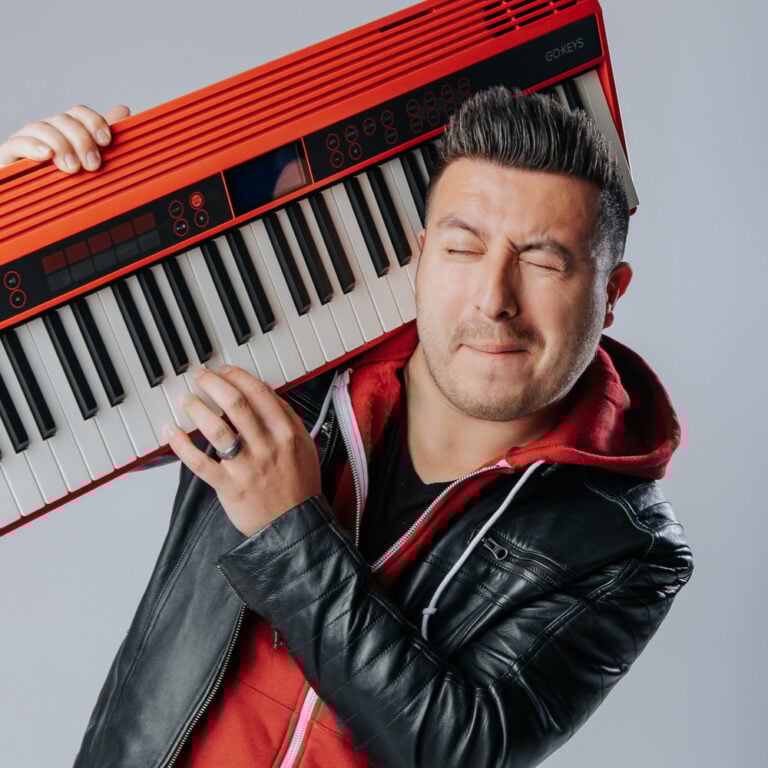
Kevin Castro is a graduate of the prestigious MacEwan University with a degree in Jazz and Contemporary Popular Music, and is the Musical Director and touring pianist for JUNO-winning Canadian pop star, JESSIA. As your instructor at Pianote, Kevin is able to break down seemingly complex and intimidating musical concepts into understandable and approachable skills that you can not only learn, but start applying in your own playing. Learn more about Kevin here.
/marketing/pianote/lead-gen/getting-started/coach.webp)
/marketing/pianote/lead-gen/getting-started/logo.webp)
By signing up you’ll also receive our ongoing free lessons and special offers. Don’t worry, we value your privacy and you can unsubscribe at any time.
/marketing/pianote/lead-gen/chords-progressions-digital-book/chord-progressions-exit.webp)
Want to play the most popular songs on piano?
Grab the Little Book of Chord Progressions to learn the most popular chord progressions used in modern music.
No credit card. No spam.
Just awesome chords to get you playing.
Don’t worry, we value your privacy and you can unsubscribe at any time.

/marketing/pianote/promos/april/trial-banner.png)