“Play me a song.”
If only it was that easy.
Unless you’re playing a fully notated piece of music with everything written out, you’re likely going to have to fill in some blanks.
Here’s what I mean.
Most songs come in the form of lead sheets or chord charts. They’re super fun and you don’t have to be able to read music to use them.
But they often have a few things missing. Take a look at the chord chart for “Let It Be” by The Beatles:
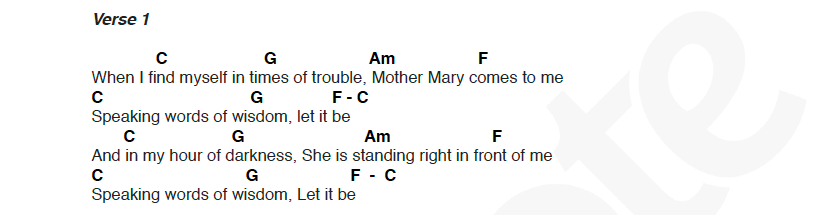
Do you see what’s missing?
There’s no intro! Anyone who’s heard the song will know that Paul McCartney doesn’t just launch into it.
So when there’s no intro, what do you do?
This lesson will give you practical tips on how to create and play your own intros, outros, and interludes so when you sit down to play a song you really sound like you know what you’re doing.
Because if you don’t, it can get pretty embarrassing. (Ask me how I know.)
I’ll be using “Let It Be” and “The Scientist” to demonstrate these techniques and you can download the chord charts for both if you’d like to follow along.
THIS IS SUPER IMPORTANT!
You want to have a feel for the song BEFORE you start to play it. It is infinitely harder to play an intro for a song you don’t actually know.
That might sound like an obvious point but it’s worth mentioning because the worst thing you can do while playing an intro (apart from playing a completely different song) is to mess up the timing or rhythm. And let me tell you, other musicians hate that (again, ask me how I know).
I find it useful to hum the tune in my head and tap my foot to help set the tempo. When I have the song and the tempo in my head I’ll play through the first 4 chords of the song (usually twice).
On the second time through I’ll hold the final chord – just to let others know that I’m about to start.
Another option for an intro is to pick out the melody from the last line of a verse or the chorus. We want the last line because it serves as a natural transition point in the song and lets everyone listening know that you’re about to start.
This is for when you see the word “interlude” or “instrumental” on a piece of music or chord chart and you’re like,
“Uuuuuhhhh, what do I do?” (cue blank stare.)
You should hopefully have some chords to work with so you’re not completely on your own.
Here’s what it looks like in “The Scientist”:
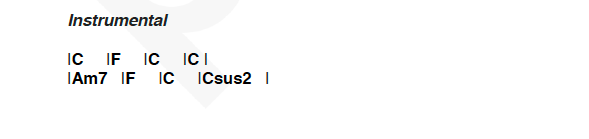
So you have some chords. But just playing the chords might be a little boring and you want to impress anyone who’s listening.
What I like to do is keep the rhythm and chord progression going, but get creative with the notes that belong to the chords.
Each chord has 3 notes that you can use, and you could try using thirds or fifths to create some movement and something melodic. If you know how to play the song’s melody you could try adding parts of it into the interlude to keep people’s attention.
You’ll want to practice this because it might take some refining. I don’t recommend waiting until the day of the performance to figure it out haha.
This part is short and sweet.
Usually, you can just play through the chords of the chorus one more time while slowing down gradually so people know you’re at the end.
You could even play your left hand an octave lower to really announce that the song is ending.
Make sure you hold that final note and let it really ring out.
So all that’s left for you to do is soak up the applause.

Lisa Witt has been teaching piano for more than 20 years and in that time has helped hundreds of students learn to play the songs they love. Lisa received classical piano training through the Royal Conservatory of Music, but she has since embraced popular music and playing by ear in order to accompany herself and others. Learn more about Lisa.
/marketing/pianote/lead-gen/getting-started/coach.webp)
/marketing/pianote/lead-gen/getting-started/logo.webp)
By signing up you’ll also receive our ongoing free lessons and special offers. Don’t worry, we value your privacy and you can unsubscribe at any time.
/marketing/pianote/lead-gen/chords-progressions-digital-book/chord-progressions-exit.webp)
Want to play the most popular songs on piano?
Grab the Little Book of Chord Progressions to learn the most popular chord progressions used in modern music.
No credit card. No spam.
Just awesome chords to get you playing.
Don’t worry, we value your privacy and you can unsubscribe at any time.

/marketing/pianote/promos/april/trial-banner.png)